Written by Nicole Schroyer
Washington, DC is a national icon when it comes to climate action. We don’t always get as much recognition as states but hey… we’re used to that. In December 2018 we officially became one of the strongest national climate action leaders. After years of intense advocacy, coming from actors such as CCAN, DC Climate Coalition, and DC residents, the DC Council unanimously passed the Nation’s most ambitious clean energy law.

- 100% renewable (NOT nuclear) energy by 2032.
- Emissions free public transportation and privately-owned fleet vehicles by 2045.
- Strong new energy efficiency standards for new and existing buildings larger than 50,000 sqft (which make up 74% of DC’s electricity driven emissions).
This. Is. Climate. Leadership.
DC’s climate leadership doesn’t stop there. In July 2019, the US Green Building Council released a report ranking the country’s greenest states by LEED square footage per capita. DC didn’t make the top ten list… but not because it isn’t the greenest, but because it isn’t a state. Actually, DC boasts more square feet of LEED certified construction per capita than any state in the US.
AND, this year, the American Council for an Energy Efficient Economy ranked DC 5th on the city scorecard, which compares emissions reducing initiatives in 75 of the largest cities around the country.
AND, the District’s median Energy Star efficiency score is 74 while the national average is only 50.
We are setting a top tier example for other cities and states, and for the world. Go us!

AND, the Catholic Charities of the Archdiocese of Washington, along with others, recently announced a plan to create DC’s largest solar array of about 5,000 panels.
AND, In August, PEPCO, the largest distributor of electricity in the District, reported that 5.4% of the energy they supply to DC is coming from renewable sources. According to the new law, 17.5% of DC’s energy needs to come from renewables by December 2019. This is where RECs (Renewable Energy Credits) come in. Pepco will make up for the 12.1% difference with these credits. When we reached out to Pepco they said they are “on track” to meet the 2020 RPS.
Sidebar: [However, as Tyrion Lannister once said, “nothing someone says before the word ‘but’ really counts”]
BUT there is more work to be done.
You probably remember that the IPCC has said we have 12 years to make unprecedented changes to our current system. The headline was everywhere. The IPCC was basically repeating what scientists and environmentalists like me (and maybe you) had already known for years. Climate change is a real AND time-sensitive issue.

That’s why DC’s climate legislation is so important. It sets a legally binding timeline for DC to cut greenhouse gas emissions in half by 2032, and sets us on the path to a carbon neutral economy in the District. Although it’s one of the most ambitious climate laws in the country, it may not be ambitious enough. The climate crisis, which we are already experiencing in DC, calls for something as tough as – if not tougher than – what we enacted.
Twelve years from 2018 (when the IPCC 1.5°C special report was released) is 2030. The District won’t even be running on 100% renewable energy by then, let alone be carbon neutral.
Michael Marshall, in an opinion piece for Forbes, explains what the IPCC’s warning really means, stating “the reality is that there is no such cut-off: just a problem that gets worse and worse the later we leave it.”
What Climate Change Means for the District:
On July 8th the District received a month’s worth of rain in an hour. Let me say that again… a MONTH’S WORTH IN AN HOUR. It’s predicted that in DC, a 1-in-100 year storm will become a 1-in-25 year storm by 2050, and a 1-in-15 year storm by 2080. We must act now before this becomes our reality.
During the deadly heat wave in late July, DC’s Heat Emergency Plan was implemented. Six lives were lost due to the heatwave. Not normal. Not okay. This is climate change. No. These are signs of a climate emergency.
What’s worse? Despite the climate emergency being felt locally, the important timeline that the climate law mandates is perhaps in jeopardy.
The District’s public transportation system is supposed to be emissions free by 2045, yet WMATA doesn’t even have a plan in place to transition to electric buses.
Vehicles are the second highest emitters in the District, comprising 23% of all emissions. The Clean Energy Act requires the DC Department of Motor Vehicles to create a vehicle excise tax incentivizing fuel efficient vehicles by January 1, 2020, yet there are no public reports on current steps being taken by these agencies.

In DC, low-income residents spend as much as 12% of their income on energy utility bills. The Clean Energy Act requires that in 2020, the Department of Energy and Environment (DOEE) and the DC Sustainable Energy Utility (DCSEU) will allocate at least 30% of the funds from the sustainable trust fund increases to low income residents for programs including energy bill assistance and workforce training. To date, no progress has been reported on these initiatives. Accountability and transparency are critical to making sure we achieve the change we need for a livable future.
Our new law funded the DC Green Finance Authority, effectively establishing one of the nation’s first Green Banks. It’s expected to attract $5 private dollars to every $1 public dollar to help fund clean
energy projects in places such as low-income communities around the District. However, corruption is already a concern for the DC Climate Coalition. Denise Robbins, Communications Director at CCAN, wrote an op-ed featured in the Washington Post, illuminating issues with the newly confirmed nominees to the DCGB board. Conflicts of interest tamper with the effectiveness of an organization that has the ability to have a positive effect of this magnitude.
Stories like these put a bad taste in DC residents’ mouths. When we lose hope, we lose this battle.
The DC government isn’t doing a great job at generating trust. And this is a government-heavy law. DC residents need transparency and clarification as to how the law is going to be implemented. There is danger in resting now. The government must be held accountable through the implementation process. We have the opportunity to solidify our role as leaders in a global transition away from carbon.
We want our law to set an example of what is possible when people work together to solve complex and seemingly insurmountable problems at a local level.
Here’s what needs to be done:
- The DC Council should request updates from the DMV and DOEE regarding their plans to create the excise tax by the established deadline of January 1, 2020.
- The DC Council should ask the DOEE and the DCSEU to report on their progress in establishing plans, including community outreach and engagement, for meeting funding goals for low income residents by 2020.
- WMATA should develop and implement an electrification plan immediately.
- The D.C. Council should pass an amendment that requires the Green Bank to establish strong oversight policies as law.
Please join us in this fight. Sign up to volunteer, stay updated through our email list, donate — one or all of the above. Anything helps. Together, we can keep moving DC forward.
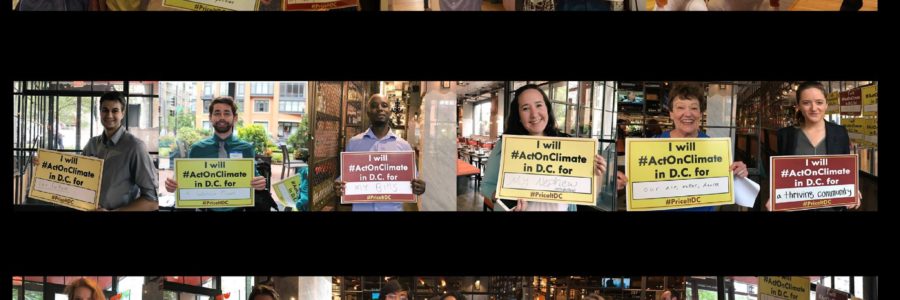
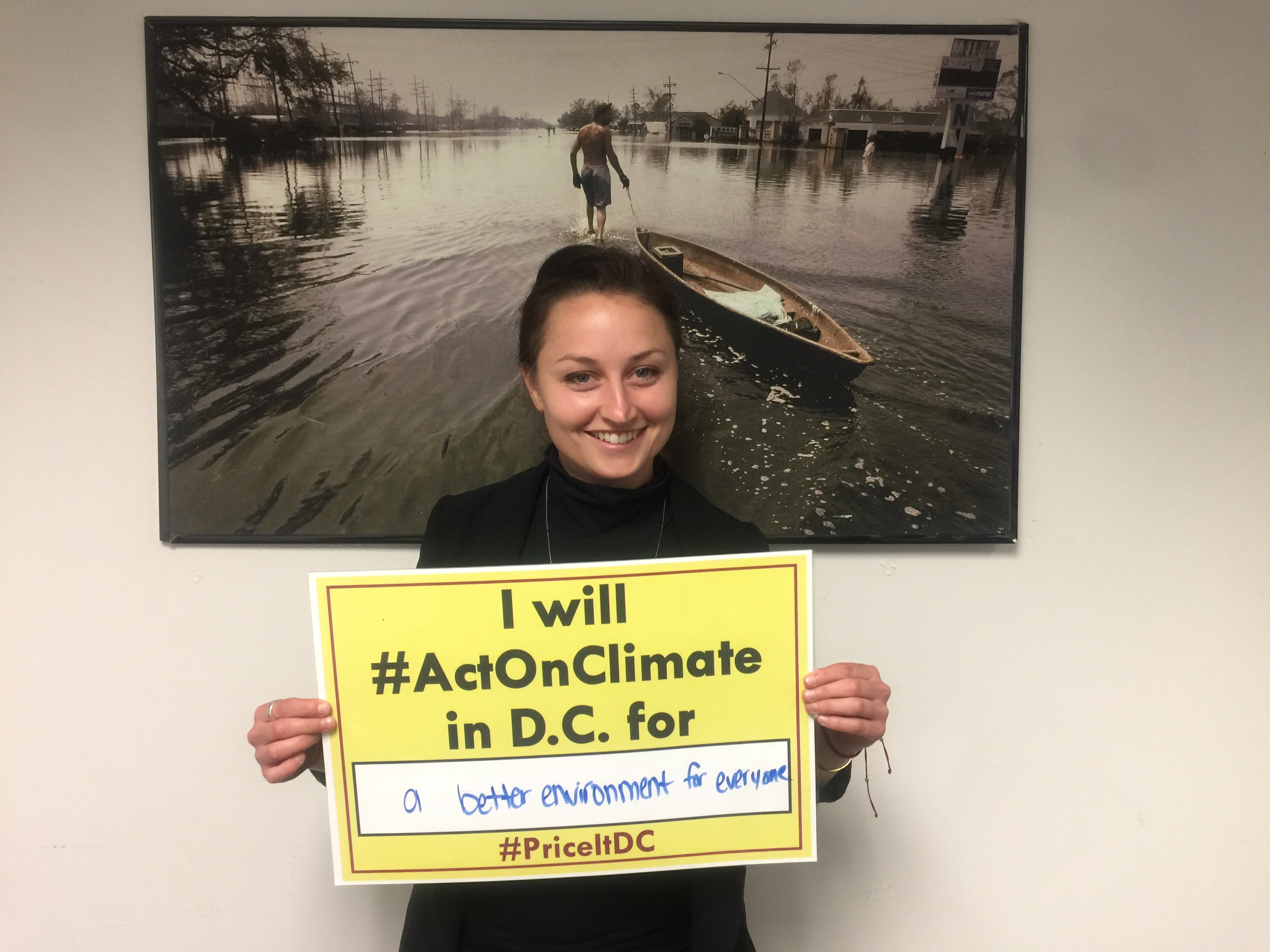
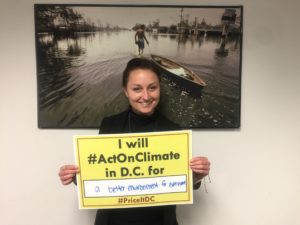

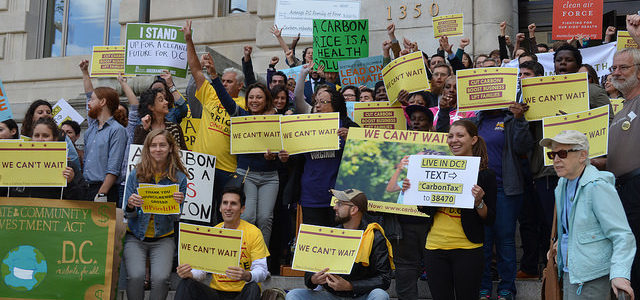
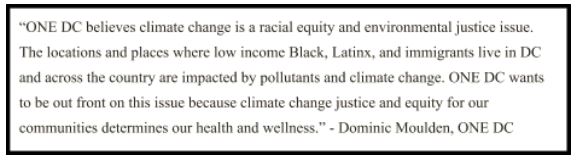 What can we do? A carbon fee and dividend will both effectively lower carbon emissions and give residents relief from our ongoing crisis of displacement by gentrification. Making polluters pay will push the city towards clean energy, but it’ll also put money in the pocketsof residents working to keep up with surging rents.
 How can one measure it? The past practice of the Council under the current Chair is to
 I have supported the DC Carbon Fee Rebate proposal because it is an opportunity to promote environmental, economic and racial justice at the same time. In the absence of federal action on global climate change, states and cities should step in to make a difference. The proposal to put a fee-per-ton on carbon and rebating the proceeds to residents is supported by prominent economists, both liberal and conservative, and environmental experts, as a market-driven way to reduce carbon consumption by encouraging energy conservation and use of renewable energy sources. The Carbon Fee Rebate proposal would rebate the proceeds of the carbon fee to DC residents on a per-capita basis. Analysis shows that for the vast majority of lower income families, the rebate will be larger than their increased energy costs. This means the proposal not only ensures that families with low incomes are not burdened by a carbon fee, but in fact will provide an income boost to these families and reduce income inequality. This proposal is an important way to promote environmental and economic justice at the same time.
 I support the proposal that a fee be imposed per ton of carbon emissions to incentivize use of renewable energy sources. In that regard, I was the author of legislation that established a renewable energy portfolio standard for electric generation — that was our first effort at promoting renewables (which are carbon free). I have given advice to the advocates for the carbon bill on how I think they can get a carbon tax adopted as law.
 I fully support the Climate and Community Reinvestment Act. The proposal requires fossil fuel companies doing business in the District to pay a fee for every ton of carbon dioxide they put into the atmosphere. The policy would then rebate the overwhelming share of the collected revenue to D.C. households and small businesses such as those in Ward 1. As the Ward 1 Council member, one of the things I would look for in any legislation is how it impacts and benefits residents and businesses in my community. I am impressed by the thoughtfulness of the Climate and Community Reinvestment Act. What is compelling to me is that Ward 1 businesses such as Cork and Pleasant Pops are behind this bill – great local businesses with engaged owners who understand what it takes to thrive in D.C. while serving as a community partner.
 I support this proposal and have been eagerly awaiting a draft bill to which I will proudly add my name. I’ve been talking with advocates about this idea for the past several years and I’m eager to moving it forward. I served as the chair of the Local Government Advisory Committee to the Chesapeake Bay Council as well as chair of the Metro Washington Air Quality board to COG. I do this work because climate change is already impacting our world and we have a responsibility to do all we can to impact the behavior of our residents to help protect our environment.
 I support the Carbon Fee and Rebate proposal.
 I am definitely in support of carbon fee rebates. For the last five years, I have been a student at the Harvard University Extension School working towards a masters in Sustainability and Environmental Management. I understand, probably better than anyone currently serving on the Council, that we must take dramatic and comprehensive action to reduce greenhouse gases or we are going to literally cook the planet. Some years ago, an organization was formed taking the name 350.org. The name was chosen based of studies that indicated that the maximum safe level of carbon dioxide in the Earth’s atmosphere would be 350 parts per million (ppm). In a few short years, we passed right through that level. Today, in February 2018, it is estimated that we have reached a CO2 level of 408 ppm. What does that mean in terms of climate change? Think about this: Globally, seventeen of the eighteen hottest years on record have occurred in this century, those years being 2001 through 2017. The other hottest year on record was 1998.
 I was one of the earliest supporters of the Put A Price On It campaign to place a fee on carbon producers, which would also provide a rebate to vulnerable residents. This campaign is part of creating a more sustainable DC. In addition to this effort, I authored the legislation creating the District’s first Climate Change and Resiliency Commission; I led the fight to have the District’s retirement and pension funds divest from carbon and fossil fuel investment holdings; I wrote several bills to expand opportunities for solar installation; and I led the effort to name 2018 as the Year of the Anacostia River to celebrate and bring attention to the river on the eastern half of our city.
 I support this proposal. I am very familiar with policies related to carbon taxes and rebates, having worked on Capitol Hill during the congressional debate of similar federal policy almost a decade ago. Policies that incentivize a shift to green energy and reduce our city’s emissions are becoming increasingly important, and policies that incentivize change by investing funds in our own communities are the optimal way to produce these results. It is also important that we pursue clean energy policy without unduly burdening low income residents who cannot afford to upgrade their homes or modify their energy source with efficiency in mind. To that end, as fees on distribution companies are increased and those costs are passed onto consumers, I would seek to revisit the percentage of carbon rebates going to our low-income residents, currently set at 15 percent. This policy is estimated to increase residential power bills by an average of $9/ month, and while that should be offset by rebates, it is an increase that could be debilitating for families who struggle to pay their bills on a month-to-month basis. We need to make sure the rebate system is designed in such a way that we are proactively insulating low-income residents from price spikes they cannot afford, particularly since they may experience these financial pressures prior to receiving rebates. I would also revise the eligibility requirements for low-income residents. I am not comfortable with requiring residents to have a photo ID or driver’s license in order to be eligible for rebates, since these requirements would inherently exclude the most vulnerable populations in our city who will depend on access to these rebates most. Presumptive eligibility would protect low-income residents from being excluded from this rebate program.
 In principle, I support putting a price on carbon emissions, and privatizing that cost to encourage the use of greener energy sources and to generally lower our collective energy consumption. This is important not only because it is good for the environment, but because it makes the District the kind of ethical place where people will want to live and raise a family as the Earth’s environmental crisis reaches a critical point.
 The Carbon Fee Rebate proposal is a brilliant way to ensure that we are good stewards of our environment and that’s both cost effective and practical. My father has been an environmental scientist focused on our water-ways for the past 30 years. We are sufferers of a large carbon footprint because of our high proportion of out of town commuters. I would take it a step further and seek ways to tax vehicle commuters from Maryland and Virginia for their carbon impacts on our city.
 I support market driven solutions to deal with rising environmental concerns. The proposed rebate incentivizes more sustainable options while relieving economic pressure on thousands of residents who are struggling to make ends meet.
 I support and campaigned for it. Down the road we should look-into using a percentage of the money to create a public utility system run on 100 percent clean energy. Putting a fee on the carbon is good, but we must now look to transitioning to a new system.